
Last Updated: October 7, 2026
AI and 3D printing are becoming increasingly connected with everyday creativity. From personalized collectibles and creative models to product prototypes and digital assets, more people are exploring how to transform ideas into physical objects. However, creating high-quality 3D content still requires professional modeling skills, and many AI-generated models need additional adjustments before they can be used in real production.
Hi3D is designed to simplify this process by connecting AI generation with practical 3D workflows. It allows users to transform images, text ideas, and creative concepts into 3D assets while reducing the technical barriers of traditional modeling. With the official release of Hi3D V3.0, the platform takes a major step forward by focusing not only on model generation, but also on improving accuracy, texture quality, and production usability.
For creators, designers, and 3D printing enthusiasts, the future of AI 3D is not only about generating models faster. The more important question is whether these models can become practical assets that can be edited, displayed, printed, and applied in different scenarios.
Table of Contents
1. From 2D Ideas to 3D Models: Making Creation More Accessible
One of the biggest challenges in 3D creation is transforming an idea into a complete model. Many users have creative concepts but lack professional modeling experience, making traditional workflows difficult and time-consuming.
Hi3D provides a more flexible approach by allowing users to start from images or text descriptions and create 3D models through AI assistance.
1.1 Turning visual references into 3D models
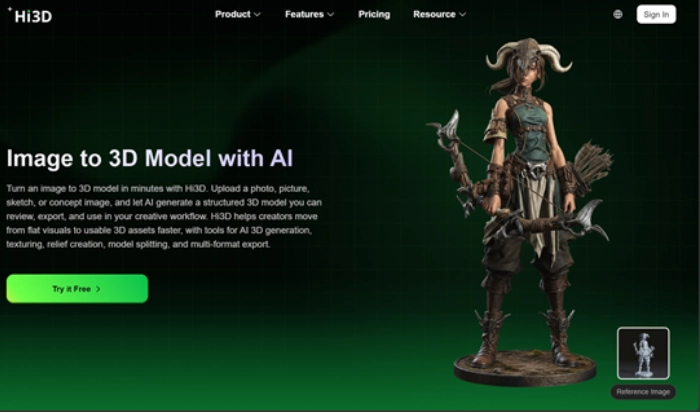
Many creative projects begin with a 2D image, such as a character illustration, product concept, or personal design. Traditionally, converting these images into 3D models requires manual reconstruction and professional software skills.
Hi3D simplifies this process by allowing users to generate 3D models directly from visual references. This capability, known as picture to 3D model, helps creators quickly transform two-dimensional concepts into three-dimensional assets.
For designers, this means faster concept exploration. For beginners, it provides an easier way to participate in 3D creation without mastering complex modeling tools.
Many creators first experiment with visual AI tools before moving into 3D workflows. Modern AI Image Generators help users turn simple text prompts into images that can later serve as reference material for AI-powered 3D model generation and design projects.
1.2 Creating models through text-based concepts
Besides image input, Hi3D also supports text-based creation. Users can describe an object, character, or creative idea and generate a corresponding 3D model.
This allows creators to start from imagination instead of existing visual materials, making AI 3D creation more accessible to a wider range of users.
The process closely mirrors modern AI Image Creation platforms, where users describe an idea in natural language and receive a visual result. Hi3D extends this concept further by transforming creative prompts into functional three-dimensional assets.
As a 3D model maker online, Hi3D provides a simple entry point for users who want to explore digital creation and transform ideas into models.
2. AI Texture Generation: Improving Visual Quality and Creative Expression
A complete 3D model is not only defined by its shape. Textures, colors, and surface details play an important role in determining the final appearance of a model.
For many creators, texturing remains one of the most challenging parts of the workflow because it requires knowledge of UV mapping, materials, and manual adjustments.
2.1 Simplifying the texturing process
Hi3D helps reduce the complexity of traditional texturing through AI-powered assistance. Instead of manually creating every surface detail, users can use AI to enhance the appearance of their models more efficiently.
This capability can be described as an AI 3D model texturing solution, helping creators produce richer and more detailed 3D assets with less repetitive work.
2.2 Higher-quality textures with improved generation technology
Texture quality is one of the important improvements introduced in Hi3D V3.0. The new version increases texture output capability to a maximum of 8K and upgrades the self-developed UV completion algorithm.
These improvements enhance pattern clarity, color transitions, and the recognition of detailed textures when models are viewed at larger scales.
For digital artists, collectible creators, and product designers, better textures allow AI-generated models to achieve stronger visual results.
3. Additional Printing Features: Connecting AI Models with Physical Production
Creating a model is only the beginning of the complete 3D workflow. To help users move from digital assets to physical objects, Hi3D V3.0 also introduces several practical printing-related features.
3.1 Multi-color printing for more detailed results
Hi3D’s multi-color printing feature helps transform textured 3D models into printable multi-color objects. It improves color region generation, filament color matching, and reduces manual color adjustments during preparation.
3.2 Split-for-printing and smart arrangement
For complex models and larger figures, Hi3D provides split-for-printing functions that separate models into printable parts and generate connectors for easier assembly.
The smart arrangement function helps users prepare models before printing by suggesting better orientations, arranging parts on the build plate, and exporting 3MF files with recommended slicer settings.
These features help create a smoother connection between AI-generated models and real printing workflows.
4. Hi3D V3.0 Official Release: A Major Upgrade from Generation Quality to Production Quality
The official release of Hi3D V3.0 marks a significant milestone in AI 3D development. Instead of focusing only on generating models quickly, this new version focuses on solving a more important challenge: how AI-generated models can become production-ready assets.
The core goal of Hi3D V3.0 is to reduce the manual repair and adjustment required before AI-generated models enter real workflows. It represents a transition from “models that can be generated” to “assets that can actually be used.”
4.1 2048³ high-precision reconstruction for more detailed models
One of the most important upgrades in Hi3D V3.0 is the improvement of geometric reconstruction accuracy.
The new version increases geometric reconstruction resolution from 1536³ to 2048³ voxel-level, becoming the first commercially available AI 3D model with 2048³ ultra-high precision.
This improvement allows more details to be preserved during generation. Small structures, surface patterns, mechanical connections, thin walls, and complex shapes can achieve more accurate reconstruction.
Compared with previous AI generation methods that may simplify or smooth out details, Hi3D V3.0 focuses on maintaining more original information from the input concept. This provides creators with higher-quality models that require fewer corrections before further use.
4.2 Stronger cross-view structure reasoning and better texture output
Another important improvement in Hi3D V3.0 is stronger structural understanding.
A single image only shows one visible side of an object, while hidden areas, back structures, and connections need AI to infer. Hi3D V3.0 improves multi-view and hidden-area reasoning, making generated structures more stable from different viewing angles.
At the same time, texture generation has also been upgraded. With up to 8K texture output and improved UV completion technology, Hi3D V3.0 improves texture continuity, edge clarity, and detailed surface presentation.
These improvements are especially valuable for models used in digital art, product design, collectibles, and other scenarios where visual quality matters.
5. Hi3D V3.0 Evolution and Industry Applications: Building a More Complete AI 3D Ecosystem
Hi3D V3.0 is not an isolated upgrade. It represents the continuous evolution of Hi3D from improving generation quality to supporting complete creative and production workflows.
5.1 From V1.0 to V3.0: The evolution toward real applications
Hi3D has developed through three major versions, with each stage improving different parts of AI 3D creation.
However, Hi3D V1.0 introduced the industry’s first commercially available 1536³ voxel-resolution image-to-3D model, significantly improving detailed structure reconstruction.
Hi3D V2.0 focused on integrated geometry and texture generation, improving structural completion and providing a more complete generation workflow.
Hi3D V3.0 further improves geometry precision, complex structure reasoning, texture quality, and production functions including smart splitting, multi-color printing, and arrangement tools.
This development path shows that Hi3D is moving beyond simple AI generation and building a more complete AI 3D production ecosystem.
Several AI-assisted workflows now combine image generation and 3D modeling technologies. Readers interested in the image-generation side of this ecosystem can explore Understanding Nano Banana 2 5 to learn how advanced AI image models contribute to creative production pipelines and visual asset development.
5.2 Supporting wider industry needs
High-quality 3D assets are becoming increasingly important across many industries, including 3D printing, digital art, game and film production, jewelry design, collectibles, education, e-commerce content, and industrial design.
Although these fields have different applications, they share common requirements: accurate geometry, stable structures, clear textures, and models that can continue into further workflows.
Hi3D V3.0 aims to reduce the difficulty of producing high-quality 3D content and help more professional users and beginners access efficient AI-powered creation.
6. Experience Hi3D V3.0 with a 48-hour free trial
The launch of Hi3D V3.0 represents a new stage for AI 3D creation. With higher precision, improved textures, and stronger production capabilities, Hi3D provides a more complete solution for turning creative ideas into usable 3D assets.
Hi3D V3.0 is officially available, and users can experience the latest version through a 48-hour free trial. During this period, users can use Hi3D V3.0 without limits on generation time and explore the upgraded AI 3D workflow.
Start creating with Hi3D V3.0 today and discover how AI can help transform imagination into detailed, printable, and production-ready 3D models.