Last Updated: October 16, 2026
Table of Contents
Introduction
NVIDIA A40 delivers the data center-based solution designers, engineers, artists, and also scientists need to meet today’s challenges. Built on the NVIDIA Ampere architecture, the A40 combines the latest generation RT Cores, Tensor Cores, and CUDA Cores with 48GB of graphics memory for outstanding graphics, rendering, compute, and AI performance. From powerful virtual workstations accessible from anywhere to dedicated render nodes, the A40 remains built to tackle the data center’s most demanding visual computing workloads.
WITH NVIDIA A40 AMPERE ARCHITECTURE
- NVIDIA Ampere architecture CUDA cores
- Second-generation RT cores
- Third-generation tensioner cores
NVIDIA Ampere architecture CUDA cores
Double-speed processing for single-precision floating-point operations (FP32) and improve energy efficiency provide significant performance improvement for graphics and simulation workflows, such as complex 3D computer-aided design (CAD) and computer-aided engineering (CAE).
Second-generation RT cores
With up to twice the presentation of previous generation and the ability to simultaneously execute ray tracing with shading or stripping capabilities, second-generation RT cores offer tremendous speed for workloads such as photo-realistic film content rendering, architectural design assessments, and virtual prototyping of product design. This technology also accelerates motion blur rendering with ray tracing for faster results and greater visual accuracy.
Third-generation tensioner cores
The new Tensor Float 32 (TF32) precision provides up to 5x the previous generation’s training performance to accelerate AI and data science model training without any code changes. In addition, hardware support for structural scatter doubles performance for the deduction. Voltage cores also bring artificial intelligence to graphics with features like DLSS, AI denoising, and enhanced editing for specific applications.
48GB GPU memory with Nvidia a40
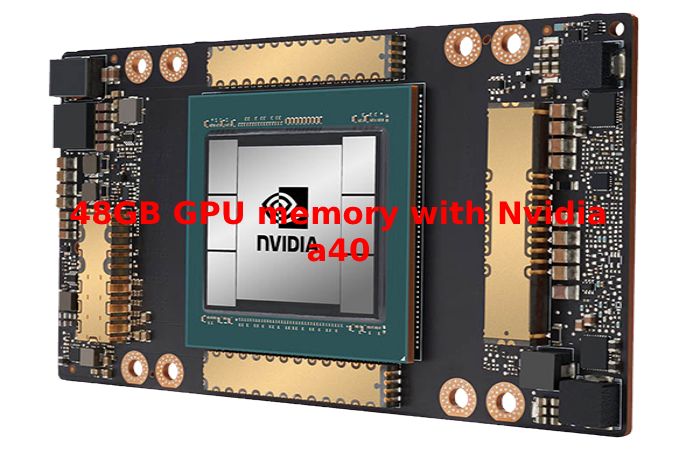
Scalable up to 96GB with NVLink, the ultra-fast GDDR.6 memory provides data scientists, engineers, and creative professionals with the large memory needed to work with massive data sets and workloads such as data science and simulation.
Organizations with rapidly growing AI workloads often compare memory-rich accelerators to determine the best balance between capacity and raw compute performance. The NVIDIA A100 40gb is frequently evaluated alongside the A40 because both target demanding data-center environments, although the A100 is designed more specifically for large-scale AI training and high-performance computing applications.
NVIDIA A40 WITH NVLink 3G
Connect two A40 GPUs to expand from 48GB of GPU memory to 96GB. Higher GPU-GPU interconnects bandwidth provides a single, scalable memory to accelerate graphics and computing workloads and address larger data sets. In addition, a new, more compact NVLink connector enables functionality across a broader range of servers.
Virtualization Ready with Nvidia a40
Next-generation enhancements with NVIDIA Virtual GPU Software (vGPU) enable more significant, more powerful virtual workstation instances for remote users, enabling high-end remote design, AI, and computing workloads.
Data Center Security and Efficiency with Nvidia A40

With a dual-slot design and low power consumption, the NVIDIA A40 is up to twice as efficient as the previous generation and compatible with a wide range of OEM servers worldwide. The NVIDIA A40 also includes a CEC 1712 chip that enables a secure and measured boot with a trusted hardware root, ensuring that the firmware has not been tampered with or damaged.
The evolution of computing hardware can be seen by comparing enterprise accelerators with earlier consumer-focused systems. Devices such as the 2013 iMac helped popularize powerful desktop computing for creative professionals, while modern data-center GPUs now deliver the scale and performance required for AI, virtualization, and advanced computational workloads.
About NVIDIA A40 PCIe
The A40 PCIe is a specialized graphics card from NVIDIA, released on October 5, 2020. Based on the 8 nm process and also the GA102 graphics processor, the card supports DirectX 12 Ultimate. The GA102 graphics processor is a large chip with an area of 628 mm² and 28.3 billion transistors. It has 10752 shading units, 336 texture mapping units, and 112 ROPs. Also included are 336 tensor cores that help improve the speed of machine learning applications.
NVIDIA has paired 48GB of GDDR.6 memory with the A40 PCIe connects via a 384-bit memory interface. The GPU runs at a frequency of 1305 MHz, which can be increased to 1740 MHz, and the memory runs at 1812 MHz (14.5 Gbps effective).
As a dual-slot card, the NVIDIA A40 PCIe draws power from an 8-pin EPS power connector, with a rated power of up to 300W. Display outputs include: 3x DisplayPort 1.4a. A40 PCIe connects to the rest of the system via a PCI-Express 4.0 x16 interface. The card measures 267 mm and 112 mm in width and features a double-slot cooling solution.
While GPU performance often receives the most attention, overall system responsiveness also depends on storage performance. Large AI datasets, rendered assets, and virtual workstation files frequently require fast and reliable storage, making it important to understand how a Hard Drive impacts data access, transfer speeds, capacity planning, and long-term infrastructure efficiency.
Conclusion
Nvidia a40 Modern data centers are evolving rapidly. Advanced technologies such as real-time ray tracing, AI, computing, simulation, and also virtual reality are standard across industries. As a result, the need to work remotely. Also above information about Nvidia a40 is helpful for all readers.